
Product · The business
The back office should reconcile itself.
Gym software keeps modeling the box as a card-payments-only, paperwork-free, single-location SaaS business. Boxes know better.
The problem
The spreadsheet is a symptom.
Every membership platform assumes a payment arrives one way: a card, charged automatically, on a schedule the software controls. Real boxes don't run on that assumption for more than a week. A drop-in pays cash on a Saturday. A local rugby club sends one cheque for six members. The kid on a scholarship gets comped, and everyone on the floor knows why. None of that has a field in most platforms, so the owner opens a spreadsheet next to the dashboard — and the moment that spreadsheet exists, the platform has already failed its one job. Not "process card payments." Reconcile the business: one ledger, one number, checked once.
Self-service reads on a features page like a convenience. It isn't — it's retention wearing an admin costume. A member who has to call the front desk, wait for a callback, and explain a two-week holiday to a human is a member for whom cancelling is the only button that actually works. A member who can pause August in two taps, see the exact resume date and the exact prorated charge before confirming, doesn't cancel — they come back in September. Every "please call to modify your plan" flow a platform ships is a small, structural nudge toward churn nobody has to log as their own.
A waiver is a legal document, not an email attachment. It needs an owner, a version, a signature, and a date that holds up months later if it's ever actually needed. Most gym software treats it as a PDF someone uploaded once — no version history when the liability language changes, no record of which version a given member actually signed, no way to tell the drop-in from fourteen months ago from the one standing at the counter today. Paperwork nobody can audit isn't paperwork. It's a hope with a letterhead.
One ledger
The plan is the contract, not a suggestion.
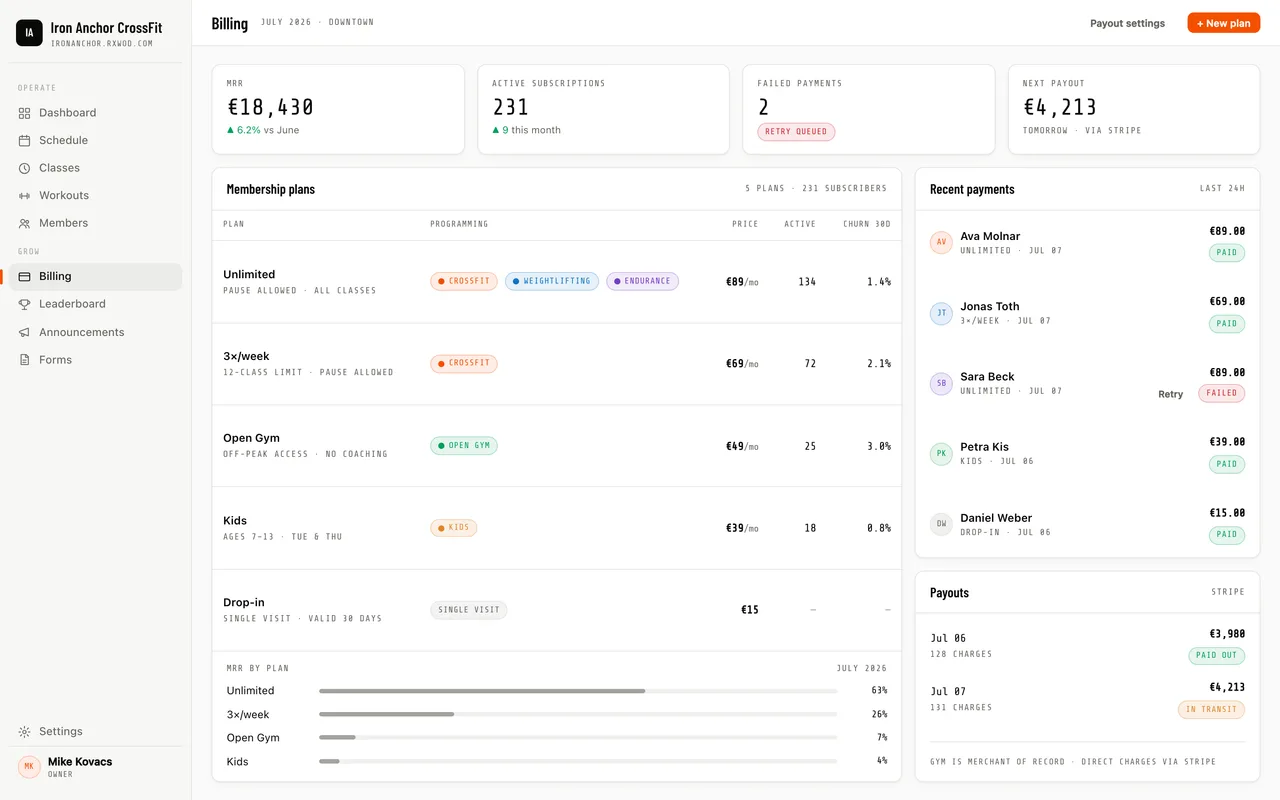
A membership plan on paper is one thing; a membership plan a system actually enforces is another. Contract terms, an early-termination fee, a class cap that actually stops the eleventh class instead of noting it afterward — the plan has to be a set of rules the software runs, not a paragraph a manager remembers to check. And when a card fails, the retry can't wait for someone to notice a red icon three days later: dunning queues itself the moment the decline comes back, on a schedule the gym sets once.
Product design preview · fictional gym data
Seven ways money actually arrives
Cash is a payment method.
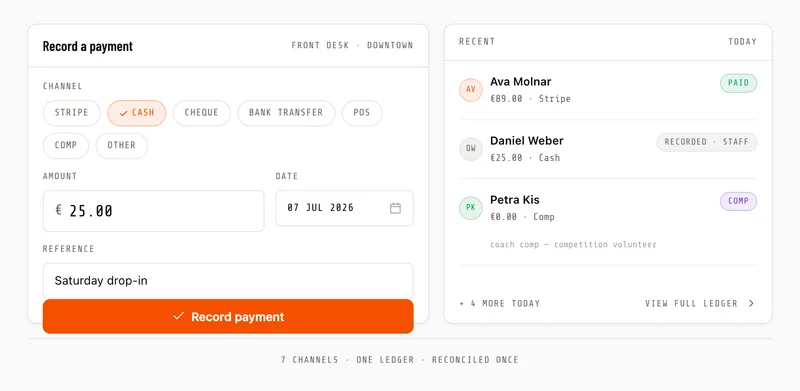
Stripe. Cash. Cheque. Bank transfer. Card on a POS terminal at the desk. Comp. Something that doesn't fit any of those and needs a line anyway. Seven channels, and every one of them gets the same treatment — a reference, a reason, the staff member who recorded it, timestamped the moment it happened. The ledger doesn't care which channel the money took to get there. It just holds all of it, in one place, reconciled the same way.
Product design preview · fictional gym data

Pause without a phone call
The member who can pause doesn't cancel.
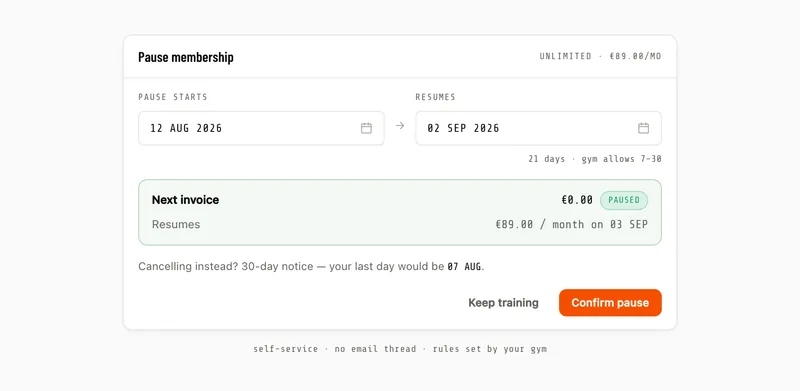
Pause windows live inside rules the gym sets, not rules the platform assumes — how many months a year, how much notice, whether it's available on this plan at all. Ask to pause and the notice-period math runs itself: the date it actually takes effect, the date it actually resumes. Proration gets computed and shown before the member confirms anything, so nobody is surprised by a partial charge three weeks later. None of it needs a phone call, and none of it needs someone in the back office running the numbers by hand.
Product design preview · fictional gym data
Documents, not PDFs
A waiver should outlive the thread it was signed in.
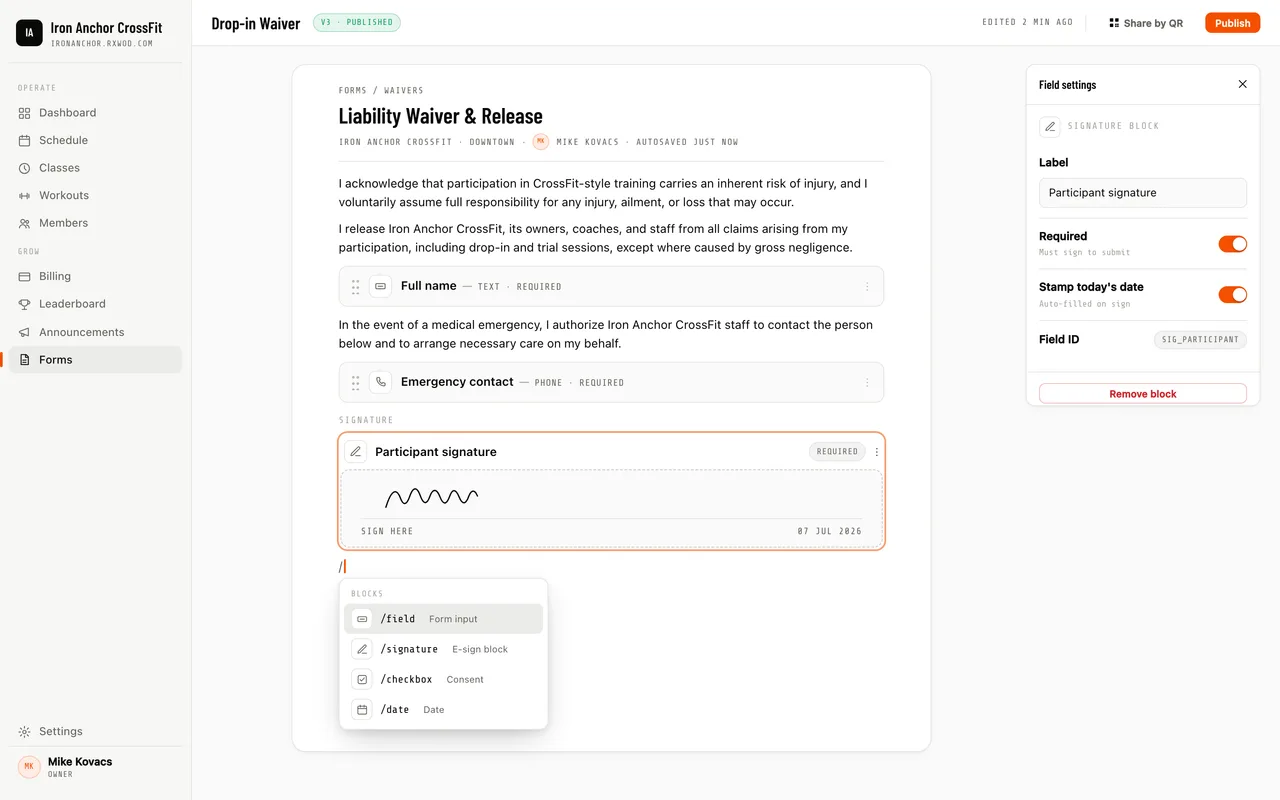
Waivers and intake forms get built in an actual document editor — slash commands to drop in a signature block or a clause, not a rich-text box fighting you over formatting. Six starter templates cover the forms most boxes need on day one. A QR code puts the form in front of a drop-in before they touch a barbell, signed on their own phone before the warm-up starts. And every form is versioned: change the liability language in March, and April's signatures are provably against the new version, not a guess.
Product design preview · fictional gym data
The specifics
7
Contracts, ETF, class caps
With notice-period math
Computed before confirm
Versioned, e-signed, QR-shareable
Multi-location roll-up

Get started
Close the books in one place.
Bring your real ledger — the cash, the cheques, the comps you've been tracking on the side. Get on the list and we'll show you what it looks like when all of it reconciles itself.