
Product · The loop
Members who see progress don't cancel.
Retention isn't a campaign you run in March. It's a loop that closes every day: train, log, see it count, come back.
The problem
Churn is a lagging indicator.
Most boxes lose something like a third of their membership every year, and the standard response to that number runs backwards: a win-back email, timed to land after the member has already made the decision to leave. That's marketing solving a problem that started weeks earlier, on the floor, not in an inbox. The cheaper intervention sits upstream — a member who logged a PR this month isn't reading a cancellation-prevention email, because nobody has to talk them out of a decision they were never close to making.
But that only holds if logging costs nothing at the moment it happens. Mid-WOD, chalk on the hands, ninety seconds before the next set — that's when a score either gets typed or gets forgotten. One thumb, one number, and the payoff has to be immediate and public: a PR flagged on the spot, a name that moves on a board someone else can see. Ask for a form, a login screen, or "add details later" instead, and the loop breaks exactly where it needed to hold.
None of this replaces the whiteboard. The whiteboard is sacred — it's the one thing every person in the room is already looking at mid-class. Digitizing it away would cost more than it saves. So the room's shared attention doesn't move to a screen; the screen wires into it. Same wall, same glance, except now every score updates live and still follows the member home after they've left the room.
The moment
The rep is the reward — show it.
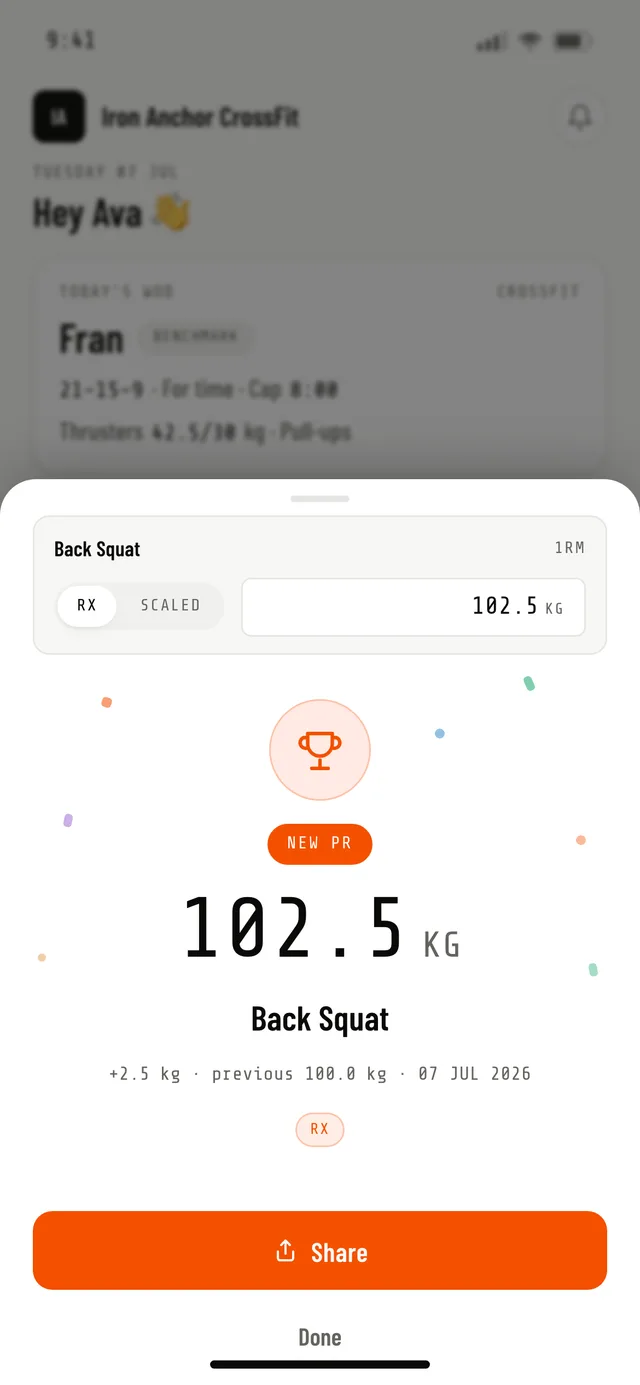
A time or a load, entered with one thumb before the next set starts. PR detection runs automatically against training history — nobody flags their own personal record, the app already knows it just beat what came before, and the delta gets celebrated on the spot.
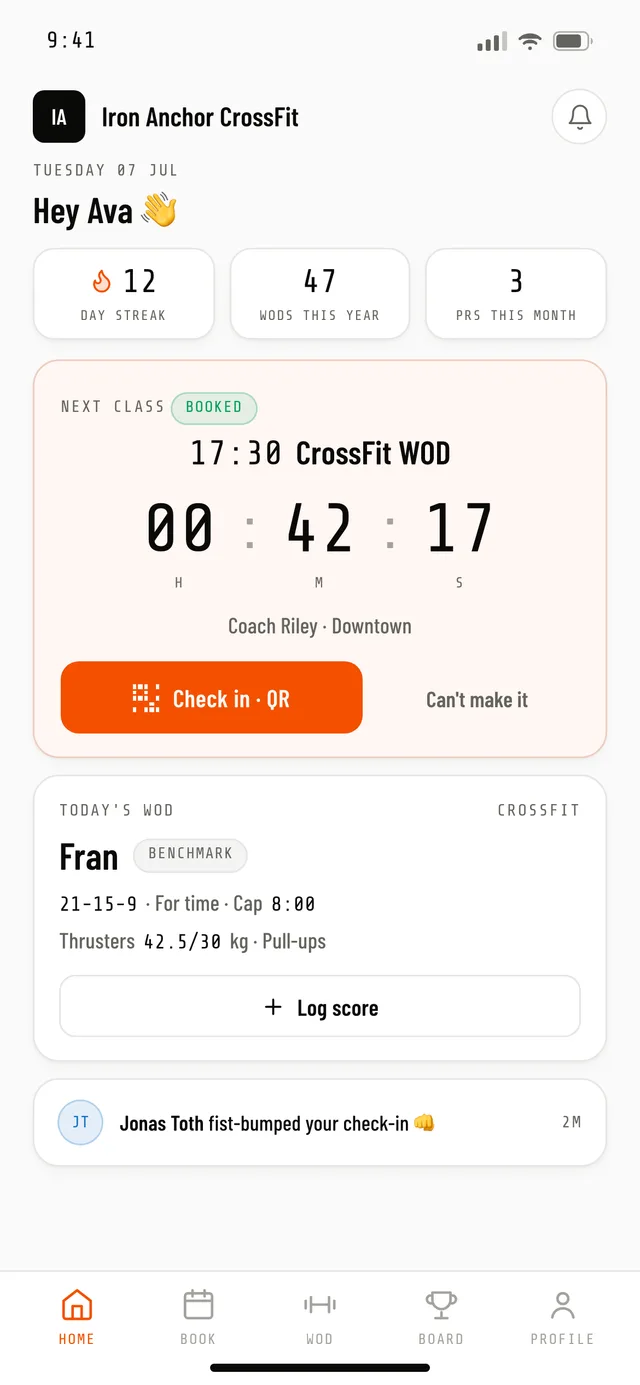
Mission Control runs the moment in reverse: not what just happened, but what's next. A countdown to the class already booked, a one-tap check-in at the door. It has one job between workouts — stay out of the way until it's useful again.
Product design preview · fictional gym data
Honest boards
A leaderboard with one column tells nine people they won and everyone else they lost.
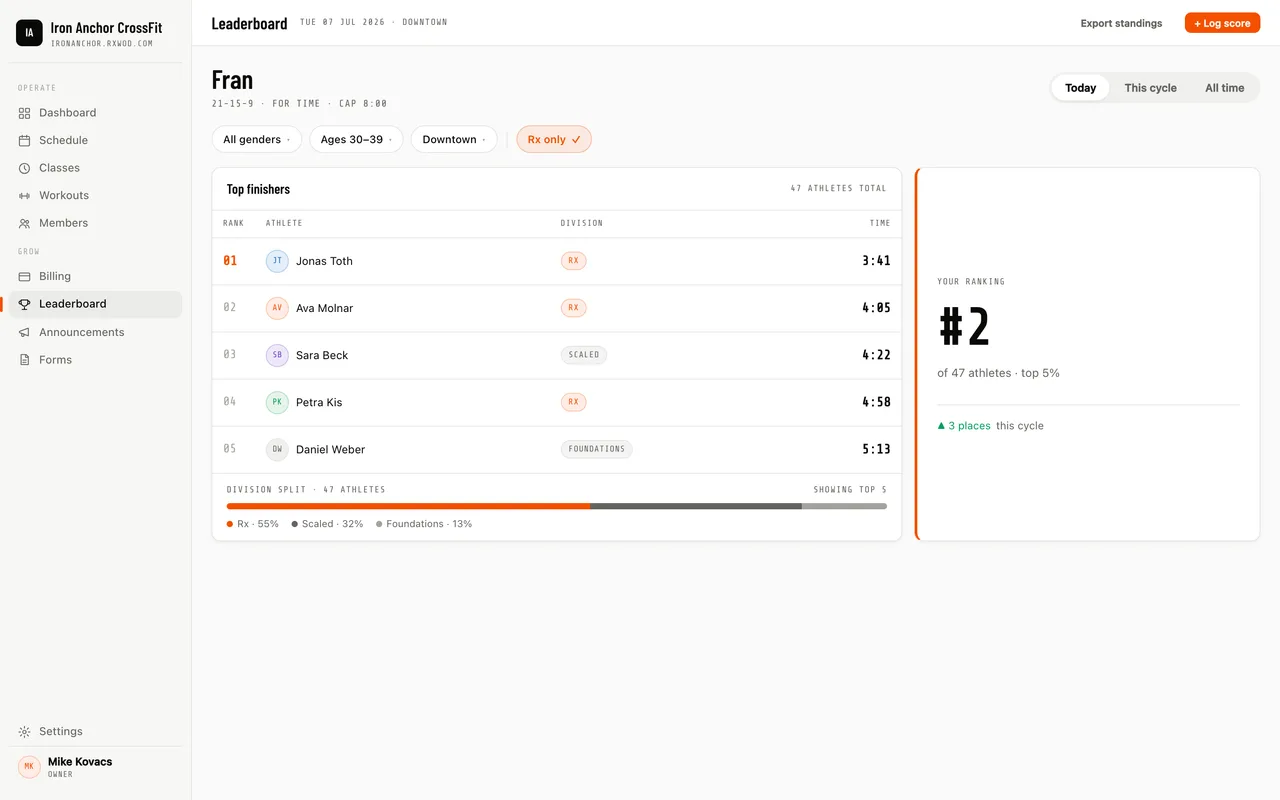
Rx, Scaled, and Foundations aren't an asterisk printed next to a time — they're divisions in the data, filtered the same way gender, age group, and location are. Sort the board the way the room actually competes, and nobody's 4:22 gets buried under someone else's Rx 3:58 just because the leaderboard only ever tracked one column.
Product design preview · fictional gym data
Closer look
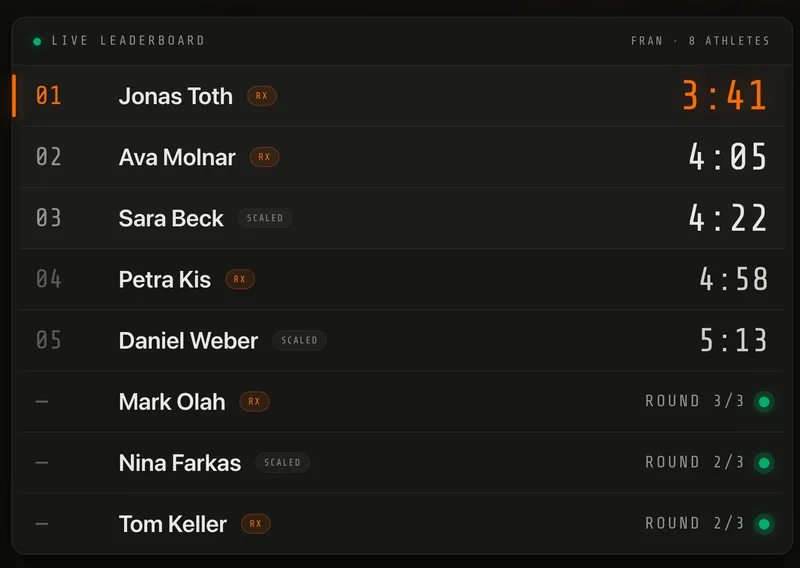
The room sees it live.
Product design preview · fictional gym data
Consistency, made visible
Most gamification is built for the podium — and a box of ninety only has three spots on it.
Everyone else needs a different number: their own. Attendance and logging streaks. Badges tied to real criteria, not "opened the app twice this week." A percentile line that says where the other eighty-nine stand — "more active than 82% of your gym" — so showing up consistently is visible even when the top of the leaderboard isn't reachable.
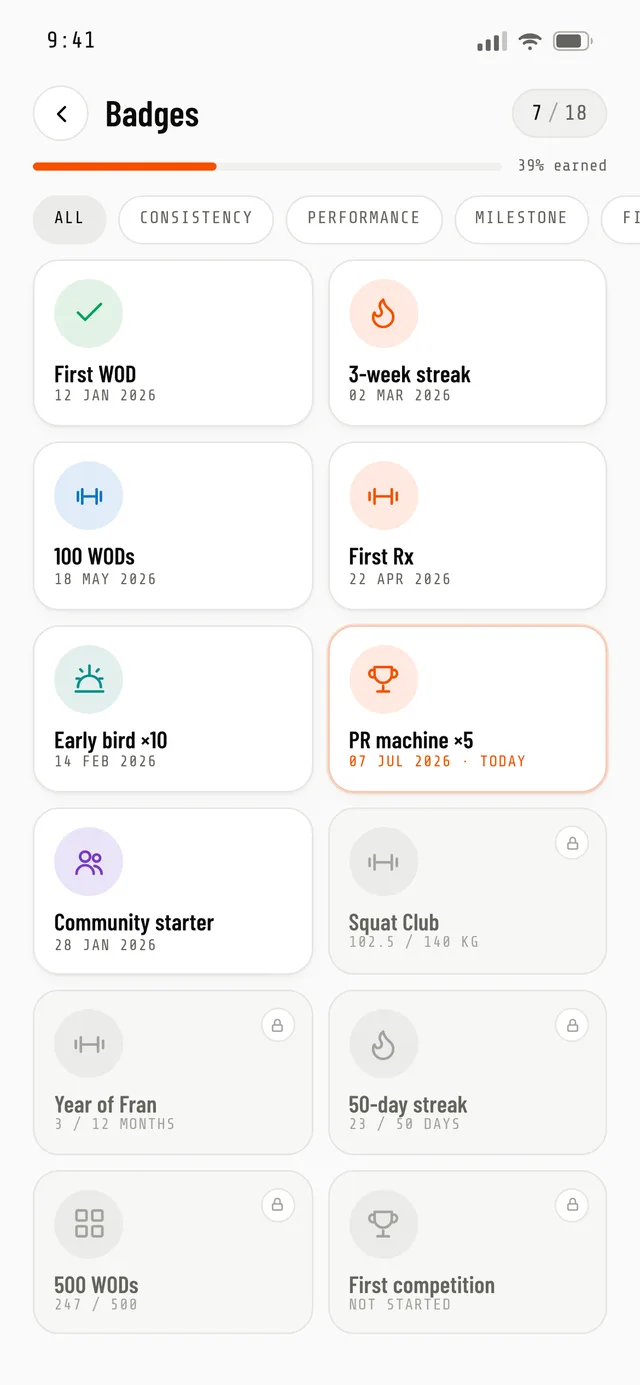
Product design preview · fictional gym data
The specifics
Automatic
4
Attendance + logging
Percentile
Live
Head-to-head

Get started
Close the loop at your box.
Bring your own board — real scores, real names, real gaps in the data. Get on the list and we'll show you what a retention curve looks like when logging is free and the delta is public.